

What AI Actually Cites: New Data Is Changing the Role of PR
/
AI engines like ChatGPT and Claude have completely changed the way we consume content. But how exactly does AI produce this content? What’s happening behind the scenes and can we influence it? Recently, I read some new reports on how AI platforms source and cite information and the findings surprised me.
Research from Muck Rack’s Generative Pulse report and Code Red and Merritt Group’s research on PR in the LLM era show that the way companies are discovered on the internet has significantly changed. This has real implications for marketing and communications teams about where to focus and how to think about influence.
Earned media is still the foundation
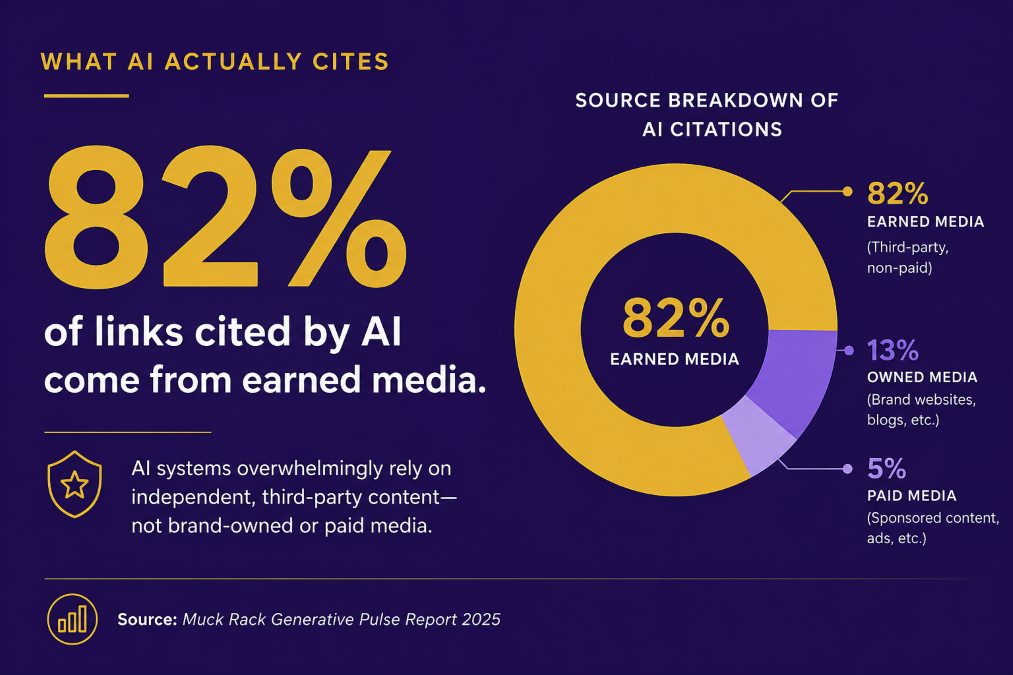
One of the most important takeaways is that AI systems overwhelmingly rely on non-paid, third-party content.
The Muck Rack research shows that approximately 82% of links cited by AI come from earned media, with journalism alone accounting for roughly a quarter of all citations.
This reinforces something PR professionals have always touted: credibility comes from independent sources.
What’s changed is that this credibility now directly shapes how AI systems describe companies and technologies.
Fresh content has outsized impact
Timing also plays a bigger role than many expect.
More than half of AI citations come from content published within the past year, with the highest concentration occurring within the first week of publication.
This suggests that visibility is not just about building a long-term presence. It also requires a consistent flow of timely, relevant coverage.
For companies, this means a steady cadence of announcements, commentary and thought leadership is more important than ever.
Not all media is equal
Another key insight is that AI systems do not treat all sources the same.
Research from Code Red and Merritt Group shows that trade publications often carry more influence than major national media outlets when it comes to cybersecurity and other technical topics. For example, in their analysis of “AI Trust Scores for Cybersecurity,” outlets like Dark Reading, Infosecurity Magazine, and SecurityWeek each scored 100, while Bloomberg ranked 34 and The Wall Street Journal 26.
This reflects how AI systems prioritize:
Technical precision
Consistent terminology
Clear, structured explanations
For cybersecurity companies, its good reinforcement that coverage in the tier 1 and even tier 2 trade outlets can matter more than coverage in the biggest business press titles.
Consistency and clarity shape AI representation
Beyond where content appears, how it is written also matters.
The Code Red research highlights the importance of semantic stability which means using precise, consistent language to define concepts.
Content that clearly explains:
What a technology does
How it works
Where it applies
is more likely to be reused and synthesized by AI systems.
By contrast, vague or overly promotional messaging is less likely to be retained. So while LLMs are not designed to prefer speciality trade publications, they are the sources that consistently articulate clear explanations and therefore are more likely to be reused in generated answers.
The journalists AI relies on may surprise you
One of the more striking findings is the disconnect between traditional PR practices and AI-driven visibility.
Data shows that the journalists most cited by AI have only about a 2% overlap with those most frequently pitched by PR teams.
This suggests that many PR programs are optimized for relationships and reach, but not necessarily for influence within AI systems.
As a result, companies may be missing opportunities to shape how they are represented in AI-generated answers.
The role of PR is expanding
Taken together, these findings point to the expanding role of media relations. PR is no longer just about visibility. It is about influencing how your company is interpreted.
AI systems do not simply surface links. They synthesize information from trusted sources to generate answers. If your messaging is inconsistent or overly broad, your company may be mentioned, but not clearly understood or accurately represented.
This raises the bar. Today, effective PR requires:
Targeting sources that shape AI-generated answers, not just traditional reach
Reinforcing consistent definitions and terminology across media and content
Producing clear, structured explanations that can be reused and synthesized
In this environment, PR is not just influencing perception. It is influencing how companies are represented at the point of discovery.
The bottom line
AI is not replacing traditional media. It is amplifying the importance of it. The companies that show up in AI-generated answers are the ones that consistently appear in credible sources, communicate clearly and stay visible over time.
For organizations looking to compete in this new landscape, PR is not optional. It is a key driver of how your company is seen, understood, and evaluated.